The Project Moon Life Vercel App is best approached as a fictional, choice-led story whose pace can be adjusted to suit the player.
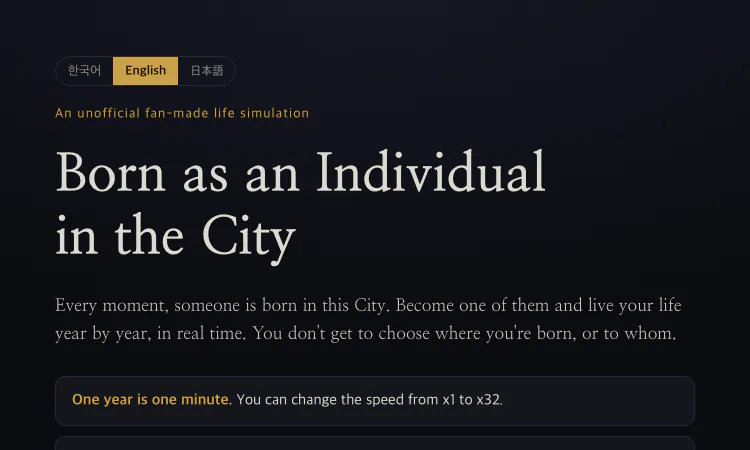
One reason to explore the Project Moon Life Vercel App is the way it makes the primary task visible without requiring a long setup. The simulation opens with a simple premise: someone is born in the City every moment, and the player becomes one of them. A name and gender start the setup, while birthplace and family remain outside the player’s control. That uncertainty gives each run its starting shape before any major decision appears. The page presents the project as an unofficial fan work, so the listing is clear about what it is. It is a browser story game built around a fictional setting, not an official release or a factual guide to the world.
For returning visitors, the Project Moon Life Vercel App offers a familiar route back to the feature or detail they want to revisit. The setting includes corporations from A Corp. through Y Corp. and the Outskirts. Some places are described as safer than others, and the player does not select a preferred district at birth. Abnormalities and Distortions belong to the fictional City’s everyday backdrop; some residents become Fixers, take requests, and, very rarely, earn the title of a Color. These details create a setting with its own vocabulary and risks. New visitors can follow the unfolding life without needing to know every reference in advance, while existing fans may recognize familiar ideas from Project Moon’s works.
The Project Moon Life Vercel App is easiest to assess by trying one small task and noticing how the interface responds. A year passes in about one real-time minute at the default setting, and the speed can be adjusted from x1 to x32. This gives a player control over whether a run feels deliberate or moves quickly through quiet periods. Major choices pause the clock so there is time to read and respond; minor choices do not wait, which keeps the simulation moving. Years without notable events can be summarized as a line of daily life. The result is an experience that alternates between quick passage and focused decision points instead of asking the player to click through every calendar year.
In a directory context, the Project Moon Life Vercel App gives readers a concise name for a product whose details are best explored directly. The visible shortcuts make the pace easier to manage: Space pauses, the bracket keys adjust speed, number keys 1–4 select a choice, and 0 lets an event pass. A visitor can watch a life unfold, intervene when a major option appears, or move past parts they do not want to dwell on. The controls are documented directly on the page, so a first session does not require a separate manual. The interface is intended for short, repeat visits as well as longer runs, depending on the pace and attention the player wants to give the story.
A typical Project Moon Life Vercel App session begins with a simple choice and grows through the controls shown on the page. An optional seed field gives players an extra way to set up a session. The site does not promise that every seed will produce a particular outcome, so it is best understood as a setup option rather than a guarantee of a fixed narrative. Starting again can be useful when someone wants to see how a different life unfolds or simply wants to approach the simulation with a new name and perspective. Because the player cannot choose a City birthplace, the appeal comes partly from seeing what the run presents rather than from building a character with complete control over every starting condition.
The Project Moon Life Vercel App suits visitors who prefer to learn through a short, hands-on session. The page distinguishes between significant decisions and smaller moments. Major choices stop time long enough to consider the options; minor ones may happen while the clock continues. Quiet stretches become a concise line of daily life, keeping the sequence legible without treating every uneventful year as a separate task. Players who want a slower story can pause or reduce the speed, while people curious about the broad arc can increase it. This balance makes the City life simulation accessible to people who enjoy interactive fiction but do not want constant input.
Over time, the Project Moon Life Vercel App can become a repeat destination for people who want to compare, create, or observe at their own pace. Fans of branching stories, life simulations, and atmospheric game worlds may enjoy watching an unfamiliar character move through an unpredictable life. The product can also work as a compact discovery for someone who wants to understand the setting’s ideas through play rather than through a long explanation. Its minimal setup leaves room for the events to carry the experience. Since the story is fictional and the run’s starting place is not selected, players should approach it as an imaginative simulation. It does not model real cities, people, or life outcomes.
The site warns that the game includes heavy themes such as death, illness, crime, and mental breakdown, and recommends it for ages fifteen and up. This content notice gives visitors a chance to decide whether the tone fits before beginning. The page also says that its numbers and events are fiction made for the game. It is an unofficial, non-profit fan work and is not affiliated with the original creators. The listing should preserve that distinction: this is a fan-made interactive experience, not a source of official lore, advice, or real-world safety information.
For a first run, Project Moon Life Vercel App offers a useful way to feel the timing before choosing a faster pace.
A new player can begin by entering a name, choosing a gender, and optionally setting a seed, then select Be born to start. From there, the screen explains the time controls and shows events as the character grows older. It helps to try the default speed briefly, pause at the first major choice, and use the shortcuts only after seeing how the pacing feels. If a moment is not appealing, the listed option to let it pass keeps the run moving. That first session can be short; the structure is designed to make it easy to return and try another life.
A life simulation is most interesting when the player notices how a small starting difference changes the mood of a run. The City’s unpredictable origins, timed decisions, and fictional events make each visit a way to explore another possible path. The player can focus on the story, experiment with pace, or simply observe what happens when they intervene less often. Nothing in the interface suggests that a single run is the definitive version of a character’s life. A return visit can therefore be exploratory: pick another name, adjust speed, and see what the next sequence brings.
Project Moon Life Vercel App works best when each session is treated as one possible City life rather than a fixed account of events.
The experience is built around narrative timing, not a promise of precise player control. Birthplace and family are explicitly outside the player’s choice, and the pace can make smaller events pass without waiting. The content note is worth reading before play, and the fan-work notice explains the project’s relationship to the source material. Visitors looking for an official game or authoritative explanation should use the creators’ official channels instead. For directory browsing, the useful question is whether an unpredictable, time-based life story sounds appealing. The preview page gives enough information to make that choice.
For this directory, Project Moon Life Vercel App supports the angle of discovery through personal interests: Discovery often starts with a personal interest: start a life in the City, set an optional seed, and choose how fast the years pass This product gives curious visitors a way to follow that interest through a tangible set of choices rather than a generic search result. Each person can bring a different goal, taste, or pace to the experience. The listing can help someone recognize whether the product fits their style, and the live page gives them room to explore further. It is most compelling when used as an invitation to try, compare, or create something for oneself, without pressure to adopt a single approach.
A visitor may ask whether the listing alone is enough to make a choice. It is a good first stop, but the live product page contains the current controls and details. Another useful question is how to begin: choose one small task, review the result, and explore another option only if it helps. The best way to decide whether the experience fits is to compare its real workflow with the visitor’s own goal. During a first visit, it is useful to treat the interface like a small experiment. Try one run at x1 to understand the rhythm, then briefly increase speed and compare the feeling. Pause when a major choice appears and notice how much the game invites reflection; use the quick-select keys only once the options are familiar. The summary line for quiet years helps preserve continuity without overloading the screen. These small observations make a second session easier to tailor. A player can return for a slower narrative, a faster overview, or simply another chance to meet a different person in the City.

AI-powered face analysis that turns a photo into detailed measurements, style insights, and personalized recommendations.
Upload a photo. Get the maker, age, and value — Antique Scanner reads marks, materials and wear so you know what your antique is worth.

Convert any image into editable layers with AI

Magic Layers – Official Website, What It Is & How to Use

Harness True Model Potential Transform Every Spark of Inspiration into Reality

Longruay - 30-day wealth decision game: manage US$100 million, pick an identity, get a private report.