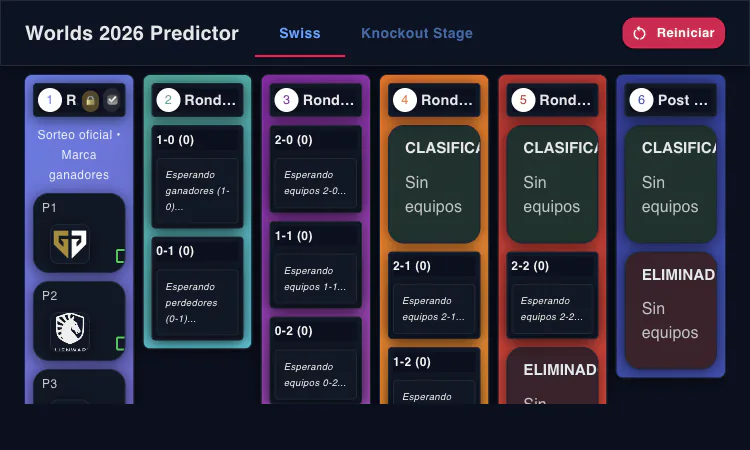
Worlds 2026 Predictor Vercel App can add an easy activity to a Worlds watch party. Friends can look at the first-round slots, take turns choosing winners, and talk about where those choices lead. The board continues into Swiss record groups, so a conversation about one matchup can naturally become a discussion about later rounds. This is more interactive than simply asking everyone to name a champion. The Worlds 2026 Predictor Vercel App gives a group a visible reference for its opinions and can make pre-event anticipation more engaging without requiring a formal competition or a long setup.
Prediction discussions are fun because people make different assumptions. One fan may choose a safe route for favorites, while another may imagine an early upset and see how the rest of the board changes. The Reiniciar control makes it easy to start a fresh attempt, and the separate knockout tab extends the story into the next phase. A group can compare routes, debate the decision that mattered most, and decide which forecast feels more plausible. The product is not a social network and does not need to be described as one; it supplies a compact board that people can use as the center of an informal conversation. A closer look at Worlds 2026 Predictor Vercel App shows the same sequence of choices and later-stage groups.
A host can introduce the interface in a few sentences: start with the eight P1–P8 matchups, choose a winner for each, then follow the record groups through the Swiss rounds. The numbered sections and waiting labels help newcomers see that later paths depend on earlier results. Someone who is less familiar with Swiss play can ask questions as the scenario advances. The knockout tab offers a familiar bracket view of a later phase. This makes the tool appropriate for mixed groups, where some people follow esports closely and others are joining because friends are watching. The Worlds 2026 Predictor Vercel App makes the format a conversation rather than a lecture.
At inspection time, the visible pairings were placeholders, not a full list of named teams. A host should confirm current match information from reliable event sources before asking everyone to make picks. The interface itself does not show a leaderboard, shared editing, or a scoring system, so groups can use their own informal rules if they want to keep score. Product copy should not imply that those group features are built in. The reliable description is simple: the app lets a user choose outcomes and explore the route. That is enough to make the Worlds 2026 Predictor Vercel App useful for a friendly prediction session.
Not every participant needs to follow every stage in detail. A casual viewer can make a few favorite picks and enjoy seeing the board take shape. Someone who loves the format can examine each record group and consider how a particular result affects qualification or elimination. The same interface can support both styles because the main actions remain visible while later detail is available on the board. A group can also split the work, with one person entering picks and others discussing them. That is a suggested way to use the app, not a claim that it has multi-user controls. Its simple interaction makes it easy to include different kinds of fans.
Before a series begins, open Swiss and move through P1 to P8 in order. Ask participants to name a winner and give a quick reason. Pause after the first choices to look at the 1-0 and 0-1 paths, then continue if the group wants to go deeper. Open Knockout Stage to complete the scenario. When everyone is ready to try a different idea, reset the board and start again. This format gives the activity a natural beginning, middle, and end. The Worlds 2026 Predictor Vercel App serves as the visual canvas while the group supplies the predictions and friendly rivalry.
When inviting someone to the page, tell them what they will see: a Spanish-language Worlds prediction board with a Swiss section, a knockout tab, and visible placeholders if the pairings are not yet filled. This lets friends decide whether they want to join and avoids confusion about the current data state. A short invitation such as ‘bring your picks and compare routes’ captures the spirit of the tool. The browser-based format makes it easy to open alongside a match stream or chat. For a group that likes making predictions together, the Worlds 2026 Predictor Vercel App is a compact way to keep the conversation organized. A further look at Worlds 2026 Predictor Vercel App can help a fan decide whether this bracket workflow fits their event routine.
This browser-based product is a prediction companion for fans following the 2026 League of Legends World Championship. The page is titled Worlds 2026 Predictor and opens on a Swiss tab. Its purpose is to let a visitor enter choices, then follow how a tournament route could develop. It is not presented as a live score service or an official source of event facts. Instead, it provides a board where a fan can organize a scenario and see the stages together. The Worlds 2026 Predictor Vercel App makes a focused task accessible in a browser: move from a first-round opinion to a broader view of possible progression, and revisit the path when a different assumption seems worth exploring.
The opening section contains eight pairings marked P1 through P8. Each pairing presents two sides and controls for identifying the winner. The page labels this section as official round-one pairings and includes controls related to locking the pairing state and round-one results. On the inspected page, team labels appeared as placeholders instead of a fully named roster. That is useful context for anyone writing about or trying the product: the bracket structure is visible, while the visitor should verify whether the current page has the match information needed for a complete forecast. Users can still learn the interaction pattern by reviewing the first-round slots and seeing how the page is organized before making any assumptions.
After the opening round, the Swiss board separates teams by their records. Visible groups include 1-0 and 0-1, followed later by 2-0, 1-1, 0-2, 2-1, 1-2, and 2-2 paths. The interface also has qualification and elimination endpoints, including 3-0, 3-1, 3-2, 0-3, and 1-3 groups. These labels show why a Swiss format cannot be treated as one simple elimination ladder: several paths advance in parallel, and a team's record determines which route it follows. Waiting messages and empty states explain that later groups depend on earlier outcomes. The Worlds 2026 Predictor Vercel App puts those pathways into one view so a user can follow a scenario stage by stage.
A separate Knockout Stage tab sits next to Swiss in the top navigation. The header also contains a Reiniciar control, giving users an obvious way to begin a different set of choices. Together, those elements support repeatable what-if use: build one possible route, inspect the later stage, reset, and compare another idea. The visible controls suggest a straightforward fan workflow rather than a long configuration process. Product copy should describe that workflow while avoiding claims that are not established by the page, such as saved prediction histories, accounts, shared editing, live feeds, statistical probabilities, or automated analysis. The Worlds 2026 Predictor Vercel App is useful as an interactive board without needing to be characterized as a forecasting engine.
A practical visit starts on the Swiss tab. The user reviews the opening slots, identifies the matchup information they want to use, and chooses a winner for each pairing. They can then inspect the record groups, continue through subsequent rounds, and switch to Knockout Stage to view the later phase. If they want to test a different assumption, they use Reiniciar and start a fresh scenario. This creates a clear cycle of choosing, observing, and revising. Fans can make a favorite-led forecast, try a more surprising set of results, or focus on one decision and see how it changes the possible route. The Worlds 2026 Predictor Vercel App keeps the user's own reasoning at the center.
The product is suited to League of Legends esports viewers who enjoy bracket predictions, tournament formats, and discussion about possible outcomes. A casual fan can use the record groups to understand the progression, while a more involved viewer can compare several routes and debate the assumptions behind them. It can be useful before an event, during a watch-party conversation, or when someone wants to revisit a hypothetical after a result. The board is a companion for fan reasoning, not a promise that a particular outcome is likely. Visitors should use official event sources to confirm participants, pairings, rules, dates, and results. When described with those boundaries, the Worlds 2026 Predictor Vercel App has a specific and understandable role in an esports fan's toolkit.

Flying Roadster AI Video Generator makes a personal flying car video from your photos, with optional driver portrait and an easy path to share the result.
GCS Cheats provides undetected game hacks, aimbots, ESP, and verified configs across 41 multiplayer titles with instant digital key delivery.
Headphone, DAC, amp and speaker reviews with pros, cons, price history and the one catch to know, from weeks of real listening. No ads, no affiliate links.

Project Moon Life is a free life simulator about personal choices, unexpected turns, and the stories that grow from a resident’s changing circumstances.

AI-powered face analysis that turns a photo into detailed measurements, style insights, and personalized recommendations.
Upload a photo. Get the maker, age, and value — Antique Scanner reads marks, materials and wear so you know what your antique is worth.
