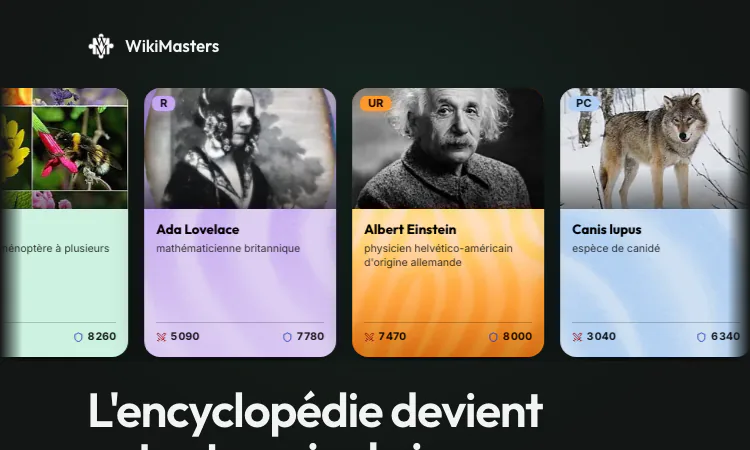
There is no single person that WikiMasters is for, which is unusual enough to be worth unpacking. WikiMasters looks narrow at first glance: cards generated from Wikipedia articles, French interface, free registration. Spend time inside it and you find at least four distinct kinds of player getting different things from the same systems. This piece profiles each one honestly, including who should stay away.
The first type never really plays the WikiMasters duels. For this player, WikiMasters is an album to complete. The album view sorts cards by tags such as Sciences and History, supports pinned favourites, and shows exactly which cards are still missing. That missing-cards list is the hook: it turns the encyclopedia into a checklist, and checklists are irresistible to a certain mind.
The collector also appreciates that WikiMasters rarity has a logic behind it. A card's tier comes from how much its article is read; attack comes from article length; defense from article quality. So the WikiMasters collection is not arbitrary. A legendary card for the Sun at 9,470 attack or the Great Wall of China at 8,970 means something checkable: these are enormous, heavily visited articles. Collectors who like understanding their sets, not just owning them, get that from WikiMasters for free.
The second type likes knowing things and being tested on them. Duels in WikiMasters are quizzes drawn from your own cards; attack scores, defense absorbs. Every card pulled from a pack is potential future ammunition, so building the WikiMasters collection and preparing for duels are the same action.
This player enjoys the strange study effect WikiMasters produces. Card descriptions come straight from Wikipedia articles, so an evening with WikiMasters means reading dozens of one-line summaries: Cleopatra VII as queen of Egypt from 51 to 30 BC, Nikola Tesla as an inventor naturalised American, Machu Picchu as a fifteenth-century Inca citadel. Nobody sits down to revise, and yet the facts stick, because a quiz question is attached to each one. For trivia people, WikiMasters is a self-building question bank where the entry fee is curiosity.
The defensive layer adds a wrinkle trivia apps lack. A common bee card defends at 8,260, better than Albert Einstein's ultra-rare 8,000. Knowing which of your cards can absorb punishment is its own knowledge game, and the quiz player tends to enjoy exactly that kind of bookkeeping.
The third type treats WikiMasters as a negotiation table. Duplicates are marked as available for trade, deals are proposed directly against missing cards, and the terms are worked out in conversation. The homepage stages the canonical exchange: do you have a double of Cleopatra VII; yes, against your Marie Curie; done.
Auctions feed the same instinct with a clock on it. Cards go up for bidding with a countdown, offers stack up, and the example on the WikiMasters site shows a live auction with seven bids and a bit over two hours left. The trader in WikiMasters lives for that final window, judging when to bid and when to let a card go.
This profile should know the stakes are reputational, not financial. Registration is free, and the WikiMasters economy runs on cards and patience rather than purchases. The pleasure is in the deal itself, which makes WikiMasters closer to a trading floor simulation than to a pay-to-win ladder.
The fourth type came for the WikiMasters guild and stayed for everything else. WikiMasters guilds bring a shared chat and a team ranking; the example guild, Les Encyclopedistes, counts twelve members with individual scores listed underneath. Friend messaging means trades and duels start inside conversations, and achievements, a general leaderboard and regular contests give the group a calendar of things to chase together.
For this player, WikiMasters functions as a small social club with a game attached. The guild chat carries the bragging about a good pull, the negotiation of who needs which duplicate, and the scheduling of grudge-match duels. The encyclopedia content becomes a shared language: everyone knows what an L-tier Sun card means.
In practice the profiles blur within a month. The collector joins WikiMasters for the album, discovers that a duplicate Frida Kahlo is exactly what a guildmate needs, and completes a first WikiMasters trade; the market instinct wakes up. The quiz player loses a duel because a question came from a card never read properly, and starts pinning and studying; the collector instinct wakes up. The social organiser recruits two friends, discovers the leaderboard, and starts duelling in contests; the competitor wakes up. WikiMasters seems designed for this drift, because every WikiMasters system touches another: the album arms the duels, the duels feed the leaderboard, the leaderboard pulls guilds into contests, the contests make duplicates valuable, and the duplicates pull everyone back into trading. A player who arrived wanting one thing from WikiMasters ends up using four, which is the standard trajectory of the longer-tenured WikiMasters players now sitting on scores like 18,940. The lesson for a newcomer: pick whichever door into WikiMasters looks most appealing, and expect the other rooms to follow.
Honesty cuts both ways, so here is the other list.
WikiMasters is not for players who want an English interface; WikiMasters and its card texts are French. It is not for anyone under 18; registration requires confirming that age explicitly. It is not for players who want sanitized content, because cards derive from real Wikipedia articles and the signup warns that sensitive material can appear.
It is also not for people who dislike derivable systems. If knowing that rarity is traffic, attack is length and defense is quality makes the magic feel mechanical, WikiMasters will feel exactly that mechanical. WikiMasters does not hide its formula; it prints it on the homepage.
The four profiles rarely stay in their lanes. The collector starts trading to fill gaps, the quiz player joins a guild for contest points, the social organiser discovers the auction sniping hobby. WikiMasters is broad enough that the doors connect.
What every profile shares is the same foundation: free registration, content from Wikipedia under its CC BY-SA licence, and an operator, Shoobidoo Labs inc., that states plainly it is not affiliated with the Wikimedia Foundation. If any of the four profiles above sounds like you, WikiMasters is worth an evening of your time.
Flying Roadster AI Video Generator makes a personal flying car video from your photos, with optional driver portrait and an easy path to share the result.
GCS Cheats provides undetected game hacks, aimbots, ESP, and verified configs across 41 multiplayer titles with instant digital key delivery.
Headphone, DAC, amp and speaker reviews with pros, cons, price history and the one catch to know, from weeks of real listening. No ads, no affiliate links.

Project Moon Life is a free life simulator about personal choices, unexpected turns, and the stories that grow from a resident’s changing circumstances.

AI-powered face analysis that turns a photo into detailed measurements, style insights, and personalized recommendations.
Upload a photo. Get the maker, age, and value — Antique Scanner reads marks, materials and wear so you know what your antique is worth.
