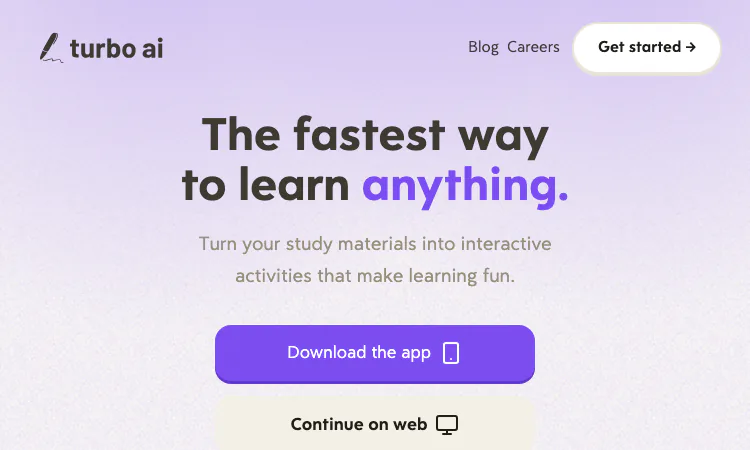
The evidence is old and stable: rereading a chapter feels productive and changes little. Recognition is not recall. You read a definition, nod, and turn the page, and the nod registers nothing about whether the definition can be reproduced at nine the next morning under exam conditions. Every study method that works, from flashcards to practice problems, works by making retrieval happen before the exam does.
The practice engine inside Turbo AI is built on that principle, and its one-line description is unusually precise about the goal: endless questions until it clicks. This piece examines the Turbo AI question system itself: what the questions look like, where they come from, and what a student should and should not expect from machine-generated practice.
The Turbo AI homepage demo of practice mode runs on American history, and the sample set is worth reading closely because it shows the format range.
One question is fill-in-the-blank: the blank Act of 1765 taxed printed materials in the colonies. One is open explanation: describe the significance of the Boston Tea Party. Others are multiple choice with plausible distractors: the treaty that ended the Revolutionary War is offered alongside Versailles, Ghent, and London, which are treaties a test writer would genuinely use to catch a half-remembered answer.
That mix matters more than it looks. Fill-in-the-blank rehearses exact recall of terms. Multiple choice rehearses discrimination between similar facts. Open explanation rehearses the essay-shaped answers that many exams weight most heavily. A practice system with only one of these formats trains only one skill, so the Turbo AI format spread is the feature, not a detail.
Generic quiz banks exist everywhere. The differentiator for Turbo AI is that practice draws from the material you upload: your lecture slides, your PDFs, your notes, the YouTube video your professor assigned. The questions land on your course's version of the subject, with your professor's chosen emphasis and vocabulary.
The workflow is short. Material goes in through the drop zone that accepts PDFs, videos, and recordings, or arrives already as notes written during class by the AI Notetaker. Turbo AI generates the study set, and the quiz becomes one of the artifacts alongside flashcards and structured notes. Because every artifact shares one source, a question you miss points at the exact section of the exact document to reread, and the definition in the flashcard deck is guaranteed to match the answer the quiz expects.
For technical courses the question quality depends on formatting fidelity, and the site addresses that directly: Turbo AI handles math formulas, chemical equations, physics diagrams, and code snippets, preserving technical formatting. An engineering student among the reviewers confirms the practice side holds up on long technical lectures, and names the flashcards specifically.
The endless part deserves a sober read. Practice mode does not stop at ten questions or one round; it keeps generating until you demonstrate the understanding. In practice this behaves like a spaced drill that refuses to let a weak definition escape, which is precisely the behavior a cramming student needs and precisely the behavior a human tutor is too expensive to provide at midnight.
The chatbot complements the drill. When a question is missed because the underlying concept never landed, answering more questions does not help; the concept needs explaining first. The chatbot plays that role against your uploaded material, so the explanation uses your course's framing rather than a generic textbook's.
The loop, then, is: quiz to find the gap, chatbot to close the concept, quiz again to confirm. All three steps happen inside Turbo AI, and the notes editor in the Google Docs style lets you annotate the fix so the corrected understanding survives into your permanent notes.
Practice also travels. Turbo AI syncs study sets across web, tablet, and mobile, so the drill that started at a desk continues on a phone in a corridor between classes. The placement sounds minor until an exam week, when the ten-minute pockets are the only study time that reliably exists; the Turbo AI apps on both major stores carry the same 4.8 rating, and the reviews are full of exactly these between-class sessions.
Honest limits, in plain terms.
Generated questions are only as good as the source. Upload a thin slide deck and the quiz will faithfully drill a thin slice of the course; Turbo AI cannot test what the material never covered. The premade AP study guides in the Turbo AI library partially cover this for standard courses, but for specialized ones the upload quality is the ceiling.
Generated questions are also not the professor's questions. They rehearse the material in the formats the engine supports, which is close to but not identical with the exam's actual phrasing. Past papers remain the best simulation of a specific examiner's habits; Turbo AI practice is the layer beneath them, the one that makes the past papers legible.
Finally, practice is work. The promise is that the work lands where it pays, on demonstrated gaps rather than on rereading strong material for comfort. The evening a student spends drilling is still an evening.
The pattern that emerges from Turbo AI's own design: capture material continuously with the notetaker, generate at the moment of need, practice against the generated sets with the format mix, and use the free tier's quizzes and flashcards, which the site confirms are included without payment, upgrading only when a full term's volume demands it.
The economics deserve one line of their own. Every practice feature described here, the quizzes, the cards, the chatbot drill, sits inside what Turbo AI gives away, and the upgrade is priced against usage volume rather than held features. Ten million learners and a 4.8 rating across more than 300,000 app reviews say the free practice layer is generous enough that many students never need to think about the paid one. The sensible habit, then, is boring: drill in the pockets of the day, mark every miss, and let Turbo AI keep score.
Practice mode is the part of Turbo AI that turns having material into knowing it, and it is the honest center of the product: no shortcut past the retrieval, just the retrieval, arranged efficiently, until it clicks.
Flying Roadster AI Video Generator makes a personal flying car video from your photos, with optional driver portrait and an easy path to share the result.
GCS Cheats provides undetected game hacks, aimbots, ESP, and verified configs across 41 multiplayer titles with instant digital key delivery.
Headphone, DAC, amp and speaker reviews with pros, cons, price history and the one catch to know, from weeks of real listening. No ads, no affiliate links.
Project Moon Life is a free life simulator about personal choices, unexpected turns, and the stories that grow from a resident’s changing circumstances.

AI-powered face analysis that turns a photo into detailed measurements, style insights, and personalized recommendations.
Upload a photo. Get the maker, age, and value — Antique Scanner reads marks, materials and wear so you know what your antique is worth.
