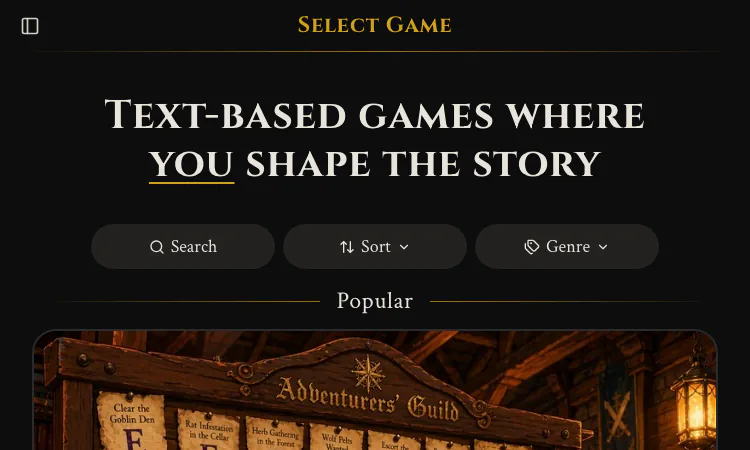
Call Questner a game and the first question is which one. The honest answer is that Questner is a shelf of them. Questner is a text-based story collection where an AI Game Master runs each entry, and the Questner catalog spans genres that rarely share a store page: fantasy epics, horror stories, detective mysteries, survival campaigns, cultivation worlds, isekai portal tales, sci-fi, cozy slice-of-life, tycoon-style management, and sandbox RPGs.
This tour walks through what the Questner range actually contains and how to find your corner of it, because breadth is the Questner product. A Questner subscription is not a ticket to one adventure; Questner is access to a library that grows every day, fed by both the team behind it and the players on it.
The Questner front page behaves like a bookstore, not a launcher. Search, sorting, and genre filters narrow the Questner shelf. A Popular row reflects what Questner players are running this week, and a Questner Recently Played row keeps your own campaigns within reach of a click. Some Questner listings are made in-house; many are community-built, published by players through the same creator tools anyone on Questner can use after signing up.
Community titles set the tone of the Questner catalog. A realism-styled London life story, a gritty street-level drama, character-driven pieces built around a single protagonist: these exist because Questner lets players publish campaigns with their own cover images, share links, and attached discussion threads. Browsing Questner feels less like picking a product and more like scanning a table of contents written by a hundred Questner authors with very different appetites.
The first question fantasy players ask about Questner is whether this is a D&D platform. The official Questner answer is no, with a caveat. Questner supports D&D-style campaigns, complete with party dynamics, quests, and dungeon-crawl pacing, but Questner is not a ruleset simulator and does not pretend to resolve initiative orders. Some Questner campaigns feel like tabletop sessions, while others are more narrative, character-driven, or story-first.
That distinction is worth internalizing before you judge Questner. If what you want from tabletop is tactical combat resolved by dice math, a text engine like Questner will disappoint you, and no Questner genre filter fixes that. If what you want is the part around the table, the banter, the held breath before a reveal, the feeling that a Questner world is listening, then the fantasy campaigns deliver that specific pleasure for a solo player. You choose your setting, character, party, and quest in the Questner builder, and the Game Master handles the rest in prose.
The tense genres on Questner benefit most from a text interface, because dread lives in description rather than graphics. A Questner horror campaign can slow the pace, dwell on a hallway, and let your own reading speed build the pressure, something a jump-scare engine cannot do on a quiet train. Questner detective mysteries use the format even more directly: you interrogate, you gather, you accuse, and the Questner narrator keeps track of what you actually know versus what you assumed.
Survival campaigns on Questner add resource pressure to the prose. Rations, weather, injury, and distance become things the Questner Game Master tracks and tests, so every choice to travel or shelter is a real wager rather than flavor text. In each of these Questner genres, the known failure mode of real-time AI narration, the occasional forgotten detail, is more visible than in fantasy, so the Questner settings that limit the narrator to one response per message earn their keep here. Turn them on before the second act of any Questner campaign.
The more distinctive Questner shelves are the ones you would not find in a Western retail lineup. Cultivation worlds, with their progression systems, sect politics, and meditation arcs, are explicitly supported on Questner, as are isekai portal stories where the premise itself is transportation into another world. These genres are first-class citizens of the Questner catalog, not community afterthoughts, and the Questner genre filters list them by name instead of folding them into a generic fantasy bucket.
Tycoon-style stories on Questner invert the usual power fantasy. Instead of swinging a sword, you build a business, an empire, or a criminal enterprise, and the Questner narrator simulates the market, the staff, and the competition responding to your management. It is a strange, compelling fit for the Questner engine: spreadsheets rendered as narrative, with the Questner Game Master keeping the books in its head while you keep making deals and hiring the wrong people on purpose.
At the quiet end of the Questner catalog sit the cozy campaigns. Slice-of-life stories in warm fantasy settings, small stakes, warm rooms, slow evenings. They are the counterargument to anyone who assumes a Questner Game Master only exists for combat and crisis. A cozy Questner session is closer to a novel that listens: you live in the town, you talk to the baker, and the Questner story notices what you care about.
Players recovering from heavier Questner campaigns use these as palate cleansers, and the Questner Recently Played row makes switching between tones frictionless. The breadth here is the point of Questner. One subscription, one Questner interface, and a shelf that runs from warmth to dread without changing platforms or learning a new Questner control scheme.
Start from the Questner genre filters, not the Popular row. Popularity on Questner measures mass taste, and the top of the Questner charts skews toward drama and grit. Read a Questner campaign's cover and tags, open it, and judge the first five messages on your own screen: the Questner narrator's prose style is fixed by the platform, but pacing and tone vary by author, and five messages is enough to tell whether a Questner author's style suits you. When nothing in the Questner catalog fits, the New Game builder turns you into the author, with publishing tools to share what you make on Questner.
That is the honest shape of the Questner library: wide, community-fed, and searchable. Questner is a text adventure shelf where fantasy epics, cultivation sagas, mysteries, and cozy evenings sit in one catalog, all run by the same tireless Questner Game Master, and all one filter away from each other.

Flying Roadster AI Video Generator makes a personal flying car video from your photos, with optional driver portrait and an easy path to share the result.
GCS Cheats provides undetected game hacks, aimbots, ESP, and verified configs across 41 multiplayer titles with instant digital key delivery.
Headphone, DAC, amp and speaker reviews with pros, cons, price history and the one catch to know, from weeks of real listening. No ads, no affiliate links.

Project Moon Life is a free life simulator about personal choices, unexpected turns, and the stories that grow from a resident’s changing circumstances.

AI-powered face analysis that turns a photo into detailed measurements, style insights, and personalized recommendations.
Upload a photo. Get the maker, age, and value — Antique Scanner reads marks, materials and wear so you know what your antique is worth.
