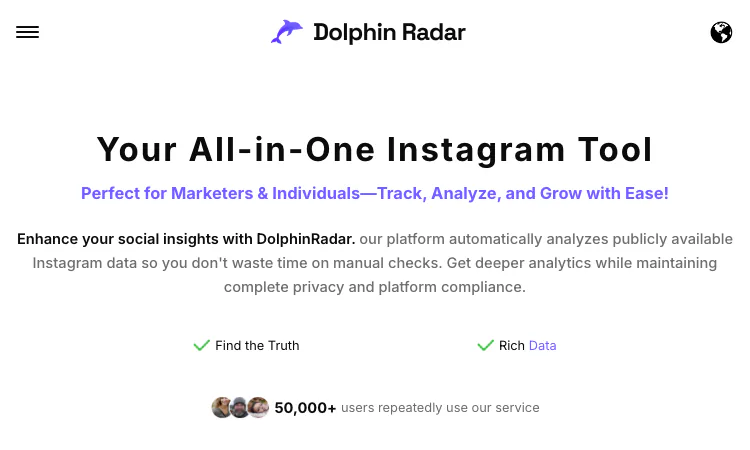
Some products make sense only after you picture the person using them. DolphinRadar is like that. On paper it is an Instagram tracking and analysis service — it watches one public account's activity and turns the record into reports. In practice, four fairly different people end up at the same checkout page.
The DolphinRadar homepage actually admits this by splitting itself into "For Marketing" and "For Individuals" sections. This piece expands that split into four portraits, then adds a fifth portrait of someone who should probably not subscribe at all. If one of them is you, the decision is mostly made.
The first portrait is the person who buys creators for campaigns. Her problem is verification: every influencer arrives with a media kit, and media kits are self-reported. Follower counts can be inflated, engagement can be purchased, and the mismatch surfaces only after the budget is spent.
Her version of DolphinRadar is an audit instrument. She browses the influencer index — DolphinRadar advertises real-time data on more than ten thousand influencers — to draft a shortlist. Then she tracks the finalists: a DolphinRadar report shows which photos a creator actually likes, whom they followed recently, and which accounts they truly interact with. The engagement patterns in a DolphinRadar report are observed rather than claimed, and that distinction is her whole job.
She probably sits on a quarterly or annual DolphinRadar plan, because her work needs the AI Insights modules — the persona sketches and lifestyle indicators that summarize months of behavior — more than it needs a single month of raw data.
Her weekly loop with DolphinRadar looks concrete. Monday, she reads the new DolphinRadar report on each tracked finalist and notes the shifts. Midweek, she exports the CSV and drops the numbers into her campaign sheet. Friday, she prunes the shortlist based on what the DolphinRadar timeline shows rather than what the pitches claimed. Nothing in that DolphinRadar loop takes more than an hour, and every step leaves an artifact she can forward. The DolphinRadar loop is short by design.
The second portrait runs accounts rather than campaigns. He maintains a brand presence, worries about reach, and answers to a founder who asks why likes fell. His week is scattered across small checks that each take too long by hand.
His DolphinRadar is the toolkit more than the tracker. The IG Shadowban Checker gives his reach anxiety a testable answer. The Unfollower Tracker and Recent Follower Tracker show whether last week's promotion kept or lost the audience. The Follower Export Tool pulls lists into his own spreadsheet, and the Hashtag Generator speeds up the publishing grind. When a specific competitor starts mattering, the same DolphinRadar account upgrades to tracking, and the periodic reports land in his lap without a Monday scroll.
For him, DolphinRadar is less a surveillance product and more a maintenance bench — a place where the small repetitive checks of account management live together.
His relationship with DolphinRadar is also reversible. When a competitor stops mattering — the launch ends, the brand pivots — the DolphinRadar subscription can be cancelled from the dashboard settings and billing stops at the next cycle. A DolphinRadar plan is a per-subject commitment, not a platform commitment, which matches how his attention actually moves. He subscribes when one account deserves DolphinRadar's continuous attention and stops when it does not.
The third portrait is the one the site itself names most directly. DolphinRadar lists individual use cases without euphemism: celebrity gossip, following the public activity of a partner's account, anonymous browsing. This is the privacy-sensitive corner of the product, and honesty serves everyone here.
What DolphinRadar offers this user is a ledger of public behavior: the photos an account liked, the follows and unfollows, the top interactions. What DolphinRadar does not offer is access to anything private — the service reads only publicly available content and never logs into the watched account. An individual subscriber sees what any patient stranger could scroll through, arranged into a report by DolphinRadar instead of collected by hand.
Whether using it this way is appropriate depends entirely on the situation and the relationship, and no tool can decide that for you. The fair statement is narrower: DolphinRadar aggregates the public record and stops at that line. Anyone hoping for more — messages, private posts, hidden data — is looking at the wrong product and will not find it here.
There is a practical boundary too: every DolphinRadar plan tracks exactly one account. A single subscription cannot fan out across a circle of people, which is a reasonable design limit on a product in this category. The one-account rule means the individual subscriber must choose a subject and live with the choice, and it caps the scale at which DolphinRadar can be pointed at anyone's social circle. That is the DolphinRadar design doing its job.
The fourth portrait is quieter. Journalists, researchers, and analysts occasionally need the activity history of a public account: a reporter covering a brand's crisis, a student studying fan communities, a writer profiling a public figure. Manual collection is possible but slow, and the archive erases itself as feeds scroll on.
For this portrait, DolphinRadar is a research assistant with a fixed beat. The detection period gathers the window, the reports preserve it, and the CSV export moves the DolphinRadar findings into whatever document the research becomes. The trending tags and top interactions in each report are exactly the aggregates this user would otherwise build by hand — and DolphinRadar keeps building them while attention shifts elsewhere.
For long projects, the annual DolphinRadar tier earns its name. The five AI Insights modules reserved for annual plans — Interests, Notable Patterns, Engaged Accounts, Discussion Topics, and Public Locations Mentioned — are precisely the aggregates a researcher would otherwise compute at the end of a study. DolphinRadar computes them continuously, so the final write-up inherits a running analysis instead of a backlog.
The fifth portrait is the person with none of these jobs. If you do not manage an account, run campaigns, research one, or follow one closely, a DolphinRadar subscription has nothing to chew on — the one-account-per-plan rule means an idle subscription produces reports about a subject you do not care about.
Pricing does not reward idle curiosity either. DolphinRadar bills monthly, quarterly, and annually, with AI Insights reserved for the longer cycles and prices shown dynamically at checkout. The occasional visitor is better served by the free DolphinRadar utilities — the story viewer, the downloader, the shadowban checker — which cover one-off questions without a subscription.
That is the honest summary across all five portraits. DolphinRadar is a per-subject instrument: it rewards anyone with one specific public account worth continuous attention, in whatever professional or personal register, and it overcharges everyone else. Decide which portrait you are before the plan page decides for you.
In every portrait the same shape recurs: one subject, one subscription, one growing record. The DolphinRadar tiers — monthly, quarterly, annual, all watching a single public account — keep that shape legible, and the DolphinRadar boundary of public data keeps it defensible. Narrow by design is not a flaw in DolphinRadar; it is the product.

Flying Roadster AI Video Generator makes a personal flying car video from your photos, with optional driver portrait and an easy path to share the result.
GCS Cheats provides undetected game hacks, aimbots, ESP, and verified configs across 41 multiplayer titles with instant digital key delivery.
Headphone, DAC, amp and speaker reviews with pros, cons, price history and the one catch to know, from weeks of real listening. No ads, no affiliate links.

Project Moon Life is a free life simulator about personal choices, unexpected turns, and the stories that grow from a resident’s changing circumstances.

AI-powered face analysis that turns a photo into detailed measurements, style insights, and personalized recommendations.
Upload a photo. Get the maker, age, and value — Antique Scanner reads marks, materials and wear so you know what your antique is worth.